When a cleaning pack needs a better seal
Cleaning product lines often carry liquids that foam, splash, or attack packaging over time. Bleach, degreasers, dish liquids, toilet cleaners, and industrial detergents all need a cap seal that gives a clean first opening and helps stop leaks in transit. On refill packs and ready-to-use bottles, the seal also helps cut down on returns from cracked closures, drips in cartons, and damaged labels.
For Durban, Pinetown, Prospecton, Pietermaritzburg, and Richards Bay producers, the issue is often not just the product inside. Coastal humidity, heat in the pack room, and long delivery runs into inland warehouses can affect how a closure performs. An induction seal adds a layer between the liquid and the cap, and for many cleaning packs that is the difference between a saleable bottle and a complaint.
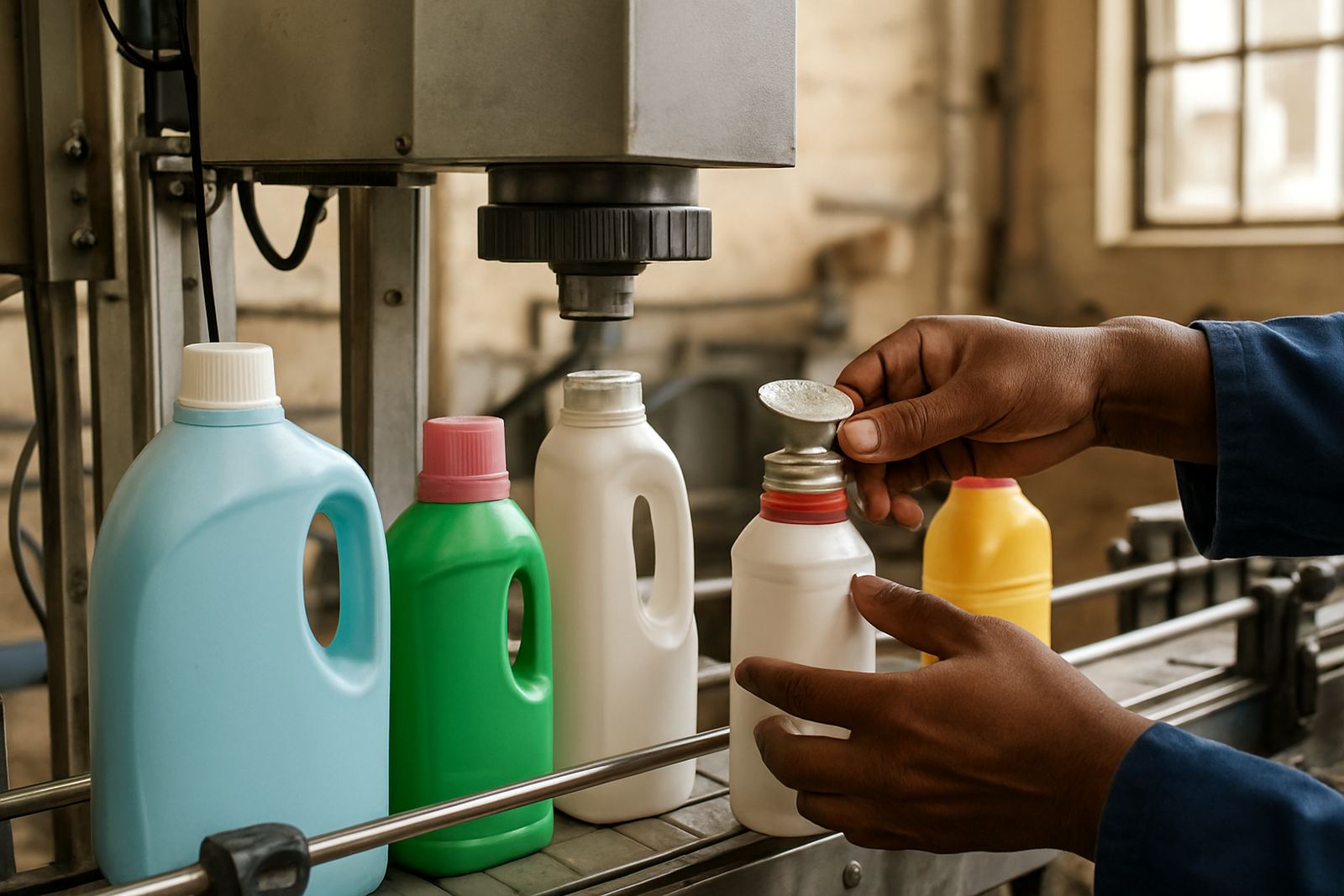
We work with fill lines where the cap is closed first, then the container moves to induction sealing before pump or trigger assembly, or before outer packing. That sequence matters because once a trigger or pump is fitted, the bottle is harder to handle and the seal station becomes awkward to place.
Typical line setup for household and industrial cleaners
Most cleaning product operations use a straightforward layout. Product is filled, capped, passed under the sealing head, then sent to labelling, case packing, or pump fitting depending on the pack type. The exact set-up depends on bottle size, neck finish, line speed, and whether the product is sold in retail packs or bulk formats for contract cleaners and facilities teams.
- Fillers for thin or medium-viscosity liquids, from 250 ml to 25 litre packs
- Cap feeders or hand-capping points for screw caps, flip tops, and trigger closures
- Induction cap sealer matched to neck diameter and liner size
- Conveyor with stable bottle spacing and guide rails
- Metal detection or leak checks where the pack spec calls for it
- Trigger or pump fitting station after the seal has been applied, where required
For many smaller sites, a single sealing head is enough. Bigger plants in Jacobs, Prospecton, or Richards Bay may need a higher duty unit on a continuous line, especially where one line runs day shift and another line is added later. We look at actual pack movement, not just the bottle count on paper.
Planning the seal station around load-shedding and plant conditions
A sealing station should be placed where bottles move in a single, steady flow. If the conveyor twists around fillers, labelers, and pack-off tables, the cap seal starts to suffer because bottles wobble or miss the coil position. The best results come from a short, well-controlled section of conveyor with enough room for an operator to check cap torque and liner placement.
In South African plants, power continuity also matters. Load-shedding can interrupt production and leave a line full of open bottles or half-sealed stock. For that reason, many sites choose a sealing set-up with predictable restart times and clear controls. The coil height, conveyor speed, and capper settings must all be easy to return to normal after an outage, otherwise the first 20 or 30 bottles can be scrap.
Where the site is close to the coast, moisture and salty air can affect electrical panels and moving parts. That means the sealing machine, control box, and nearby steelwork should be inspected regularly, and the area should stay clean from caustic drips and detergent spray. A tidy pack room may not sound exciting, but it saves real money.
Common mistakes we see on cleaning lines
Most sealing problems come from layout or liner choice, not from the product itself. A bottle may be perfectly filled, but if the cap thread is wrong, the liner is the wrong size, or the induction head is set too high, the seal can fail under storage or transport. That is why liner matching is part of the job, not an afterthought.
- Using a liner that does not suit the cap diameter or bottle neck finish
- Running the conveyor too fast for the capper and sealing head to keep up
- Allowing trigger bottles to pass through before the seal has cured properly
- Ignoring cap torque, especially on smooth plastic caps
- Putting the sealer too close to splash points, causing contamination on the top of the bottle
- Skipping operator checks after a product changeover
We also see cases where the seal is fine on day one but weak after a week because the product fumes or the pack room temperature changed. That is common with stronger cleaning chemicals. A proper trial should cover the product you sell, not only water on a test bench, and the pack should be checked after a few days too.
Budget ranges for cleaning product sealing equipment
Budget depends on whether the line is small, semi-automatic, or built for higher output. In South Africa, a basic induction sealing setup for cleaning products may start from about R65 000 to R120 000 for simpler applications. A more complete line section, with conveyor integration, better controls, and commissioning, can sit between R140 000 and R320 000. Larger or faster plants with tighter control requirements can go beyond that.
It is wise to budget for installation, trial runs, and operator training as well. If a site is in Durban, Pinetown, Pietermaritzburg, or Richards Bay, travel and callout costs are usually manageable, but the real cost saver is getting the first setup right. A failed seal run, returned stock, or a weekend breakdown usually costs more than the price difference between a basic and a well-matched unit.
Preventive maintenance and spare liners should also be part of the yearly budget. Many cleaning packers keep a small spares allowance for heads, belts, and control parts because an hour of downtime on a busy shift can throw off the whole dispatch plan, especially near month-end.
Installation, training, and support from Jacobs to the rest of the country
Bottle Sealers is based in Jacobs, Durban and supports sealing lines nationwide. We assist with site installation, line commissioning, operator training, seal validation, preventive maintenance, breakdown repairs, spares supply, liner matching, line optimisation, and remote support. That support is useful for cleaning product makers who need quick help when a bottle spec changes or a pack fails a drop test.
Our team handles jobs across Jacobs, Durban, Pinetown, Prospecton, Pietermaritzburg, and Richards Bay, and we work with sites that need a practical solution rather than a complicated one. Sibusiso Mthembu oversees the business, with Nokuthula Dlamini on operations, Jared Naidoo on technical sales, Lindokuhle Khumalo coordinating service, Megan Govender handling customer support, and Themba Zulu on field commissioning. If the line needs a quick call, a site visit, or help after a product switch, the support is direct and to the point.
For cleaning products, the goal is simple: keep liquid where it should be, protect the pack, and make sure the first opening feels secure to the customer. A good seal does that quietly every day, and that is exactly what the line should be doing.